
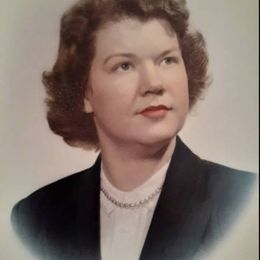
Ann Elizabeth McCroskery, born Ann Elizabeth Weinbrecht, died peacefully on Thursday, September 17, 2026, at OakBridge Terrace at St. Andrew’s Estates of ACTS Life CCRC in Boca Raton, Florida. She was 101, just five days short of her 102nd birthday.
Ann was born September 22, 1924, in Dayton, Montgomery County, Ohio, the daughter of Roger Carl Weinbrecht and Gertrude Lucile (Poland) Weinbrecht. She grew up during the Great Depression as one of several children in a family in which responsibility was not simply expected but learned by doing. Her mother possessed perfect pitch and played the piano, while her father was remembered for the persistence and courtesy with which he conducted his courtship. Ann inherited, and developed throughout her long life, intelligence, practicality, determination, and a strong sense of responsibility.
As a young girl, Ann took responsibility for her younger siblings. Her family was of German Lutheran background, and during the Depression she would bundle up the children and take them to church with her. She believed that children needed both moral education and structure. That early habit of assuming responsibility became one of the defining characteristics of her long life: she practiced responsibility herself and taught it by example.
Nursing, Medicine, and Education
An outstanding student, Ann entered the U.S. Army Cadet Nurse Corps in October 1943 during World War II. She received scholarship-supported nursing education at Springfield City Hospital School of Nursing and became a registered nurse in February 1946. Although her training took place during wartime, she was never called overseas.
Nursing became the foundation for a professional life that would continue through many decades and through enormous changes in American health care.
At Lenoir-Rhyne College, Ann studied pre-medical subjects while also providing clinical nursing care to students, staff, and faculty. She told her family that she minored in Bible. She was reportedly active in the college's Girls' Athletic Association and enjoyed swimming. Photographs from her nursing-student years show her with fellow students in swimwear, and she was remembered as an enthusiastic swimmer and diver.
Her interests were therefore already broader than nursing alone. Medicine, health care, education, physical activity, and Christian faith were all becoming parts of her developing life.
At one point, Ann was offered a full scholarship to medical school. That opportunity did not become her path. In 1949, she gave birth to her son, Maynard S. Clark. Motherhood changed the course of the opportunity that had been offered to her, but it did not end her intellectual or professional development. She largely raised her son as a single mother, with support from her church community, while continuing to work and pursue further education.
Indeed, the years that followed show how determinedly she continued to build a professional life.
Cleveland, General Electric, and Baptist Bible Institute
During the period when Ann and Maynard lived in Cleveland, Ann worked full-time as an industrial plant nurse at General Electric while attending Baptist Bible Institute (BBI) of Cleveland full-time. She was already a college graduate, but she continued to pursue education in a different academic and religious setting while simultaneously working and raising her young son.
This was an extraordinary combination of responsibilities: she was simultaneously a mother, a full-time working nurse, and a full-time student. She was able to do this in substantial part because of the family of Dr. Kenneth Amsler, a Baptist minister who was closely associated with Baptist Bible Institute. Amsler served in a leadership role at BBI, including as its dean, and was part of the institutional and missionary network surrounding the school. He was also associated with the Cleveland Hebrew Mission, reflecting the broader evangelistic and missionary work with which he was involved.
The Amsler family consequently represented much more than convenient childcare. Maynard lived with the Amsler family while Ann worked and studied, and they cared for him during the periods when his mother could not be with him. Their household provided the practical support that helped make it possible for Ann to combine full-time employment with full-time study.
The connection also placed Ann and Maynard within a wider community of strongly committed Christians. They knew Dr. Amsler and his family, as well as Christian missionaries and others involved in religious service. Maynard later encountered Dr. Amsler again, decades afterward, at Ann's church in Boca Raton. By then Dr. Amsler's first wife had died and he had remarried, so Maynard met his second wife as well.
These Cleveland years are important not merely because Ann attended BBI, but because they illustrate a pattern that recurred throughout her life: education, employment, family responsibility, and practical service developed simultaneously rather than sequentially. She was working in an industrial environment at General Electric, studying at a Bible college whose dean and community were connected with missionary work, raising a child with the help of another family, and continuing to build the knowledge and experience that she would later apply in nursing education, health-care administration, and professional practice.
From Child Development to Education and Administration
Ann's education was not simply a matter of accumulating credentials. Her interests repeatedly expanded from one field into another.
She took courses in child development, which became a bridge to later study in education. After returning to Springfield, she pursued further study at Wittenberg University, including work in special education and gifted education.
Her educational path therefore extended beyond nursing and medicine into questions of human development, education, and individual differences.
She also completed her BBI education through Cedarville College, following the institution's significant transition from its earlier Presbyterian identity to a Regular Baptist institution.
Her professional responsibilities in Springfield likewise continued to grow. She worked in nursing and health care and eventually managed the nursing education program at Springfield City Hospital, overseeing the nursing school in which she herself had received her professional training.
That was a significant transition: the young woman who had entered the nursing school as a student eventually returned to direct the education of nurses who were following in the same professional path.
She later worked with Dr. Warren G. Elliott, DDS, the new oral surgeon in Springfield, when he established his specialty practice. Ann brought to that work the combination of clinical knowledge, nursing experience, organizational ability, and administrative competence that she had developed over many years.
Only much later did her son fully appreciate how much she had contributed to making that practice function and develop. Ann did not boast about her accomplishments. Some of what she had actually done therefore became apparent only with the passage of time.
Her professional life had by then expanded well beyond conventional nursing. It included patient care, nursing education, administration, practice management, and the practical organization of health services.
Christian Faith and Service
Ann's Christian faith was equally enduring, although it developed within the larger history of her family and its religious traditions.
Raised in the Lutheran tradition, Ann later became a Baptist. She valued direct engagement with the Bible and chose a church tradition that she felt placed particular emphasis upon Scripture rather than merely upon inherited denominational custom or human opinion.
In Springfield, she was a member of Blessed Hope Baptist Church. There she organized the church nursery so that parents could leave their younger children in the care of a registered nurse while participating in adult worship. Her nursing skills thus became a practical form of service to other families in the congregation.
Her Christian relationships extended well beyond a single congregation. Ann and, later, Hamilton had many friends who were Christian missionaries, and missionary organizations and Christian service were part of the social and religious world in which they lived.
Marriage to Delmar and the Move to Florida
In 1965, Ann married Delmar Franklin Scott, who had built the family home. He proposed repeatedly, often arriving with bunches of flowers, until she accepted.
Their marriage deserves to be understood as a major chapter of Ann's life rather than simply as a transition between jobs.
In 1967, when Delmar retired, they moved to Boca Raton while Maynard was attending Wheaton College. The move required Ann to leave behind her work, church, friends, and family in Springfield. She nevertheless made the move with Delmar and began a new life in Florida.
Golf became an important part of their life together. Ann took up the game and quickly became an excellent golfer. They belonged to a local golf club and played frequently, enjoying golf as recreation and as one of the principal activities they shared.
After approximately a decade in Florida, Delmar died in the late 1970s.
Ann was widowed relatively early in her Florida life, but she continued to build a full life rather than retreat from it.
Hamilton and a Second Chapter in Florida
Ann later met Hamilton McCroskery, MD, at Bibletown Community Church in Boca Raton. They married, and their shared Christian faith became an important part of their life together.
They participated in missionary societies at the church, which later became Boca Raton Community Church. Ann served for a time as president of the Women's Missionary Society.
This marriage therefore joined her life with another community of Christian friends, missionaries, and people engaged in religious service.
Continuing Education and Professional Development
Ann continued her education and professional development throughout her life.
Her studies included Lenoir-Rhyne College, Baptist Bible Institute, Cedarville College, Wittenberg University, and Florida Atlantic University.
At Wittenberg, she pursued advanced study in gifted education. At Florida Atlantic University, she worked in the Student Health Services clinic, managing the clinic and seeing patients while pursuing a master's degree in Health Services Administration and gerontology, which she earned as Ann Scott.
Pursuing additional study in gerontology extended her longstanding interests in health, medicine, education, and human development into the study of aging.
Her professional experience likewise continued to encompass clinical care, administration, education, and health-services organization. She had worked at Springfield City Hospital, General Electric, Mercy Hospital in Springfield, Boca Raton Regional Hospital, and Florida Atlantic University Student Health Services.
For many years, she also participated in the Nurses' Health Study conducted by Harvard-affiliated researchers.
Her lifelong pattern was remarkably consistent:experience → observation → further education → new responsibility → further applicationShe did not simply accumulate degrees or positions. She repeatedly carried what she had learned from one setting into another.Nursing led into education and administration. Industrial nursing exposed her to a large organizational environment. Child-development study contributed to later work in special and gifted education. Nursing education led to management. Clinical and administrative experience contributed to her work with Dr. Elliott. Later study in health-services administration and gerontology extended interests she had been developing for decades.
Later Years
Ann lived at St. Andrew's Estates of ACTS Life CCRC in Boca Raton beginning January 22, 2009. She initially lived independently and eventually moved to assisted living at OakBridge Terrace.
She lived through the Great Depression, World War II, the transformation of nursing from the 1940s into the twenty-first century, enormous changes in medicine and health care, and more than a century of American social change.
Those who knew Ann will remember her for her intelligence, practicality, organizational ability, resilience, religious conviction, and dedication to work. She was not a person who needed to announce what she had accomplished. Much of what she had done became apparent through the responsibilities she assumed and the institutions and people she left better organized or better cared for.
Perhaps the simplest way to understand Ann is through the responsibility she repeatedly accepted throughout her life: responsibility for younger brothers and sisters; responsibility as a mother; responsibility as a nurse and health-care professional; responsibility as an educator and administrator; responsibility in managing a professional practice; responsibility as a wife; responsibility as a church member; responsibility as a student; and responsibility toward the people and institutions entrusted to her care.
Her life was therefore not a simple progression from one occupation to another. It was a continuing process of learning, working, adapting, serving, and assuming responsibility.
Ann's life was long, purposeful, and remarkably varied. She met the circumstances of each period of her life with intelligence and determination. She continued to learn, work, serve, and enjoy life for nearly 102 years.
She spoke about looking forward to being with her Savior. For those who share that faith, there is comfort in believing that she is now with her Savior.
In her final years, Ann received devoted care from her caregiver, the Trustbridge hospice team, and the staff of OakBridge Terrace at St. Andrew's Estates. Their compassion, attentiveness, and care were deeply appreciated.
A gesture of comfort
Have flowers delivered
Offer your condolences to the family of Ann Elizabeth McCroskery with a delivered floral arrangement.
Send flowersOrdering, payment and delivery handled by our partner Florist One.
Messages of sympathy
Leave a message of sympathy
Share a word of comfort with the family of Ann Elizabeth McCroskery.